Saturday, October 9, 2010
Lemons
"When life gives you lemons" you can't really make lemonade since life didn't give you a knife, cutting board, purified water, sugar, or cups of any kind. So really all you're left with are lemons. Sucks to be you.

Sunday, September 12, 2010
Price
How much is a human life worth?
Is it worth the entire world? Can you put a price on it? Maybe the net worth of the person? I don't know, but certainly a human life isn't that important. Take, for example, those who have died in wars. Yes, we all learn in school how many casualties there were, and we can even record the approximate number of those who died due to disease rather than in battle. But can you name all of them? I can't. So how are they important? What did they give their lives for? So a bunch of awkward middle-schoolers can hopelessly fail to memorize how many died in some past war? They, as an individual, are now only considered statistics, one of possibly thousands who just died... maybe by some bullet, maybe by their own men, maybe by excrement in the river. But no one in ten years would ever remember. Isn't a human life worth the entire world? No.
You can put a price on a human life. Slaves. Thomas Jefferson bought slaves, the very man who wrote the American Constitution. He read the price tags on their flesh. He paid for them. There were people who would sell themselves into slavery just so they wouldn't starve. Prostitutes, their bodies had a price tag as well. How much are you worth?
Is a person's worth measured by how much they made in life? Maybe. Who's the richest man in the world right now? Carlos Slim Helu. Is his life the most precious? Is his life the most valuable? Maybe. Then why isn't he at the top of the world? Why isn't he King? Why don't people remember him for his childhood? Why don't people remember him for his other talents? His other passions and life? Maybe they do. I sure don't. Maybe a person's worth is measured by how much money they make in life. Then what about Jesus Christ? He's our Savior, he is the son of God. He has forgiven us for all of our sins. He wasn't the richest man in the world, but he is revered by a great majority in the United States and in the world. Is Carlos Slim Helu revered by a great majority in the United States? Is he being worshipped? No? Then does that mean his life is worth less than that of Jesus? Then does that mean a person's worth isn't measured by their net worth?
All in all, a person's life is worth something. But that's only for a single person. You. Only you are worth something. Only you are worth the world. Because only you know what the world looks like. Only you know what the world feels like. Only you know what the world sounds like. Only you know what the world smells like. Only you know what the world tastes like. If you weren't born, the world would cease to be. There would be nothing. Everyone else doesn't matter. Everyone is selfish. Everyone is worth the world, but only they see it that way.
Is it worth the entire world? Can you put a price on it? Maybe the net worth of the person? I don't know, but certainly a human life isn't that important. Take, for example, those who have died in wars. Yes, we all learn in school how many casualties there were, and we can even record the approximate number of those who died due to disease rather than in battle. But can you name all of them? I can't. So how are they important? What did they give their lives for? So a bunch of awkward middle-schoolers can hopelessly fail to memorize how many died in some past war? They, as an individual, are now only considered statistics, one of possibly thousands who just died... maybe by some bullet, maybe by their own men, maybe by excrement in the river. But no one in ten years would ever remember. Isn't a human life worth the entire world? No.
You can put a price on a human life. Slaves. Thomas Jefferson bought slaves, the very man who wrote the American Constitution. He read the price tags on their flesh. He paid for them. There were people who would sell themselves into slavery just so they wouldn't starve. Prostitutes, their bodies had a price tag as well. How much are you worth?
Is a person's worth measured by how much they made in life? Maybe. Who's the richest man in the world right now? Carlos Slim Helu. Is his life the most precious? Is his life the most valuable? Maybe. Then why isn't he at the top of the world? Why isn't he King? Why don't people remember him for his childhood? Why don't people remember him for his other talents? His other passions and life? Maybe they do. I sure don't. Maybe a person's worth is measured by how much money they make in life. Then what about Jesus Christ? He's our Savior, he is the son of God. He has forgiven us for all of our sins. He wasn't the richest man in the world, but he is revered by a great majority in the United States and in the world. Is Carlos Slim Helu revered by a great majority in the United States? Is he being worshipped? No? Then does that mean his life is worth less than that of Jesus? Then does that mean a person's worth isn't measured by their net worth?
All in all, a person's life is worth something. But that's only for a single person. You. Only you are worth something. Only you are worth the world. Because only you know what the world looks like. Only you know what the world feels like. Only you know what the world sounds like. Only you know what the world smells like. Only you know what the world tastes like. If you weren't born, the world would cease to be. There would be nothing. Everyone else doesn't matter. Everyone is selfish. Everyone is worth the world, but only they see it that way.
Monday, June 14, 2010
Scanning
 "... Oh nuts the sun exploded"
I can finally scan images into the computer now, thanks to a friend named Ray (a.k.a. X-ray a.k.a. Ray Xublahaha). So I scanned this thing. The speech bubble can be hard to read, so i put in a caption.
~C.
Thursday, June 10, 2010
The Mountain
Society is like a mountain. People will always try and struggle to reach the top, where life is good and you can see and experience so many things; where you can view everything, rather than at the bottom, where you can only see so little and have nothing. In the middle, people will struggle and climb to the top, but naturally there will not be enough room there, so once it gets crowded, the climbers fight each other and push one another down, competing for the desired spot.
The questions, now, is what the conditions are for going 'up', and what exactly the 'top' and 'bottom' are. In this contemporary age, it seems that the conditions in order to climb the ladder, or 'mountain', of society is rooted in monetary and financial aspects. The richer you are, the more power you have, and the more power you have, the more things you can experience, such as vacations, which is an obvious example, but also businesses, having to deal with more people, and the more things you can purchase or own. Political power can also be a condition, but I think you are more weighed down and burdened by political power rather than monetary value, since there are more problems to be dealt with, many more enemies, in my opinion, and more criticism all around. Spiritual values is also debatable as a condition, some people belonging to Hinduism, for example, might compare the 'mountain' to the caste system, in which Brahmans are at the top and the untouchables, or animals (Sorry, I am not an expert in the field of Hinduism.), are at the bottom, and you must do good deeds in order to move up the caste system once you die and become reincarnated. Though the caste system is a bit more inflexible than my own thoughts about the 'mountain', and I think it really only pertains to Hindus in India (The caste system is gone now, I think, like I said, I'm not an expert at this stuff.). The conditions are still a bit vague, and can be argued.
The 'top' of the mountain is the most desired place, for most. But what exactly is it? If the condition for climbing the 'mountain' is monetary, then the 'top' should be the richest person in the world. If the condition for climbing is political, then the 'top' should be Dictator of the World, president of the United States of America (or leader of any of the big countries), or maybe a monarch in the old times. If the condition for climbing is spiritual, then the 'top' should be either "God(s)" or perhaps "enlightenment" (The quotation marks depict broad, general terms in a universal sense). Some examples of people who have attempted to get to the 'top', or might have reached it, are Hitler, Napoleon, Warren Buffett, Carlos Slim Helu, etc. The 'top' may be way out of the reach of humans or it might be something that is attained by few people through luck, talent, and hard work.
~C.
The questions, now, is what the conditions are for going 'up', and what exactly the 'top' and 'bottom' are. In this contemporary age, it seems that the conditions in order to climb the ladder, or 'mountain', of society is rooted in monetary and financial aspects. The richer you are, the more power you have, and the more power you have, the more things you can experience, such as vacations, which is an obvious example, but also businesses, having to deal with more people, and the more things you can purchase or own. Political power can also be a condition, but I think you are more weighed down and burdened by political power rather than monetary value, since there are more problems to be dealt with, many more enemies, in my opinion, and more criticism all around. Spiritual values is also debatable as a condition, some people belonging to Hinduism, for example, might compare the 'mountain' to the caste system, in which Brahmans are at the top and the untouchables, or animals (Sorry, I am not an expert in the field of Hinduism.), are at the bottom, and you must do good deeds in order to move up the caste system once you die and become reincarnated. Though the caste system is a bit more inflexible than my own thoughts about the 'mountain', and I think it really only pertains to Hindus in India (The caste system is gone now, I think, like I said, I'm not an expert at this stuff.). The conditions are still a bit vague, and can be argued.
The 'top' of the mountain is the most desired place, for most. But what exactly is it? If the condition for climbing the 'mountain' is monetary, then the 'top' should be the richest person in the world. If the condition for climbing is political, then the 'top' should be Dictator of the World, president of the United States of America (or leader of any of the big countries), or maybe a monarch in the old times. If the condition for climbing is spiritual, then the 'top' should be either "God(s)" or perhaps "enlightenment" (The quotation marks depict broad, general terms in a universal sense). Some examples of people who have attempted to get to the 'top', or might have reached it, are Hitler, Napoleon, Warren Buffett, Carlos Slim Helu, etc. The 'top' may be way out of the reach of humans or it might be something that is attained by few people through luck, talent, and hard work.
~C.
Monday, April 5, 2010
whut?
So today, as my sister told me about The Last Song movie, talking about how some girl's dad was dying....
I realized...
We are all dying.
Every second we live is a second closer to our death.
You may think this is a bad thing...but how could it be bad?
This view means that each second you live wasting time or doing something you don't want to be doing is a second you'll never get back. A part of your lifespan disappears, floats off into oblivion meaninglessly.
So do what you want to do. Do everything as if you're dying, because you are. Live with no regrets!
Thursday, March 18, 2010
Appendix.
Today, while reading my biology textbook for homework, I had an epiphany.
Jean-Baptiste Lamarck, a French naturalist, proposed to the world in 1809 that changes in an environment caused an organism's behavior to change, leading to greater use or disuse of a structure or organ. The structure would become larger or smaller as a result, and that these changes would be passed on to an organism's offspring.
Observations by Charles Darwin on his voyages to the Galapagos Island revealed that though the islands were very similar in climate and geology, the animals that inhabited each island were completely and totally different. Darwin concluded that this must because animals migrated there from South Africa, separately, to each island, and slowly, started adapting, and evolving to meet the needs of survival on their particular island.
Ladies and gentlemen of the jury, I would like to propose a new idea. A radical idea, one that would change the way we think about the world.
You know that small thing we have inside ourselves, the appendix?
Truthfully, it serves little purpose to us.
It has been suggested that the appendix is a lymphatic organ, rich in lymphoid tissue, necessary to create lymphoid cells that fight off viruses and invaders to the body.
However, it can be removed, and no one is exactly sure of what it does now.
But this is NOW.
What about THEN?
What if the mammals, near the time of the age of dinosaurs, had the ability. to breathe. fire.
It was no meteor that killed the dinosaurs. It was no ice age.
IT WAS THE MONKEYS THAT RAN AROUND BREATHING FIRE.
After the monkeys had completed their genocide of the dinosaurs that had terrorized the world for eras, most of the monkey population settled in peace around the world, and stopped using their fire-breath-inducing appendix. Eventually, their appendix shrunk and lost it's function as the monkeys evolved, and became an organ aiding the immune system as we became humans.
The rest of the monkeys that did NOT want to stop breathing fire would begin to shed their fur and live in tropical climates, developing a cold-blooded body and scales, and later becoming what we believe to be dragons. Later, the dragons migrated to the Europe and East Asia from the equator zone, the locations of many dragon myths.
While dragon-monkeys evolved, one group of monkeys, smarter than the rest of the peace-monkeys, decided to make the harsh pilgrimmage to what would be known as the Mayan civilization, in order to get away from the stupid ones.
Their journey was harsh, climbing mountains, fighting off dragon-monkeys, traveling without food for days at a time. They eventually had to adapt to their environment, they had to evolve, just as Lamarck and Darwin demanded it.
So they developed ESP. They developed the power to SEE INTO THE FUTURE (near future, mind you). This ability greatly ensured their survival as they traveled.
Finally, when they reached the coast of Texas, where the land and food was plentiful, some of them realized that they had actually gone off their original course. Others just didn't care about going to Maya anymore and just wanted to stay in Texas, where they would be ensured a lifetime of happiness rather than make another harsh and desperate trip to Southern Mexico.
And so, the group split up again, half of them traveling southward, the rest staying for luxury. The journey was completed much faster due to less supplies needed to be consumed by less monkeys. By this time, the monkeys were almost human, and they had reproduced to make several generations, and their ESP was growing stronger with each new generation.
By the time they reached their destination, their ESP had become so powerful that they had foreseen the horrible death that would come to all of life on Earth by December 21, 2012, as well as having developed a revolutionary planetary-based calendar system.
And so, they planned ahead, creating their calendar and purposefully stopping at 2012, to give humanity a warning of what was to come.
Then most of the Mayans, now almost completely human, died because of overworking on developing the calendar, and the rest died because they had ended up in-breeding within families too much, and they became susceptible to a deadly disease, what was to become known as HIV.
While this was happening, the monkeys in Texas lost their ESP slowly while becoming humans. However, most Texans still retain their ninja-like reflexes and ability to see within the near future.
There are firebreathers out there, humans with mutated appendixes that still allow them to breathe fire. The genetic code has not been completely lost.
And that is the story of why our appendixes are small.
~BKH
Friday, March 5, 2010
Gravities
War. What is war? War is conflict, wrought about by clashing needs, competition, and wrapped up in ideals. So what causes conflict? Regional differences which cause certain settlements to have either a surplus or a shortage of needed resources. Then what causes regional differences? The earth's spherical shape which causes sunlight to rain down upon the populations unevenly. And what causes earth's spherical shape? Gravity, which brought about the formation of earth from nebular dust and formed it into a spherical mass. What causes gravity? I sure don't know, but from this logical standpoint, gravity is the most indirect, and yet most important, cause of war on earth. If world peace is to be attained, then gravity must go.
~C.
~C.
Friday, February 26, 2010
Exist.
You do not exist. At least until you are beneficial to another person, opposing another person, or acknowledged by society or a higher authority. No one exists when they are born.
People never take notice of other passerby. They are both strangers to each other, alien. Nothing is known between them, nothing known from them. They do not exist to each other. The only people that exist are people that are known. Friends, family, famous celebrities, possibly a classmate only whose name is known. We are all ghosts, never truly seen clearly by those who do not believe in us. Abraham Lincoln, he would not be a nationally, or possibly internationally, known figure, would he not have been acknowledged by the American society for his deeds. Your friends, why are you friends with them in the first place? Because they benefit you in some fashion, either to support you, make you feel accepted, maybe even to make you feel better about yourself. They exist because they are useful. Your enemies, rivals, jerks you hate, they exist to you because they oppose you in some fashion, even if they aren't actively aggressive to you know, they probably were in the past. You know them, so in that case they exist.
Most people want to be seen, they want to exist. They try to become accepted into society, most likely to make society acknowledge them as a great person. If that doesn't work, they try to become useful to society, becoming friendly with anyone, to help people out. The easiest way to exist, is to become the opposition. Rejecting everyone, while trying to prove themselves right. Lashing out to make people see them, not as ghosts, but as humans. Is this existence?
~C.
People never take notice of other passerby. They are both strangers to each other, alien. Nothing is known between them, nothing known from them. They do not exist to each other. The only people that exist are people that are known. Friends, family, famous celebrities, possibly a classmate only whose name is known. We are all ghosts, never truly seen clearly by those who do not believe in us. Abraham Lincoln, he would not be a nationally, or possibly internationally, known figure, would he not have been acknowledged by the American society for his deeds. Your friends, why are you friends with them in the first place? Because they benefit you in some fashion, either to support you, make you feel accepted, maybe even to make you feel better about yourself. They exist because they are useful. Your enemies, rivals, jerks you hate, they exist to you because they oppose you in some fashion, even if they aren't actively aggressive to you know, they probably were in the past. You know them, so in that case they exist.
Most people want to be seen, they want to exist. They try to become accepted into society, most likely to make society acknowledge them as a great person. If that doesn't work, they try to become useful to society, becoming friendly with anyone, to help people out. The easiest way to exist, is to become the opposition. Rejecting everyone, while trying to prove themselves right. Lashing out to make people see them, not as ghosts, but as humans. Is this existence?
~C.
Saturday, January 30, 2010
World Peace
All the good little boys and good little girls wish for peace in the world. No conflict, no hatred, a world in which guns are thrown away and everybody has good relations. No war. But, what would it take for such a thing to take place? A change in the population in which everybody has no opinion, where everyone is the same? A surplus of resources and good conditions everywhere? An outside threat to everyone that creates unity? What does it take to create world peace?
A change in which everyone becomes the same doesn't seem like the optimal choice in this utopia, and it certainly doesn't seem very realistic. Differing views stem from differing conditions in the environment and possibly genetic make-up, which creates variation among individuals. A surplus of resources and good conditions might work, but it would require a miracle for something like that to happen, and plus this surplus will contribute to the growing global population, and soon there wouldn't be enough to feed everyone again, so conflict over resources would yet continue. An outside threat to everyone could possibly work, foreign terror can be a powerful unifying force, as individuals usually band together in the face of adversity(ex. the September 11th, 2001 terrorist bombings on the Twin Towers), but it could also work in the opposite direction, panic and confusion could drive different groups of people against each other, creating a divisive force in the population.
These are some theoretical situations in which all peoples of the world form friendly bonds with one another and end all wars (or conflicts) in the world. But what would actually work? Can you think of some things?
~C.
A change in which everyone becomes the same doesn't seem like the optimal choice in this utopia, and it certainly doesn't seem very realistic. Differing views stem from differing conditions in the environment and possibly genetic make-up, which creates variation among individuals. A surplus of resources and good conditions might work, but it would require a miracle for something like that to happen, and plus this surplus will contribute to the growing global population, and soon there wouldn't be enough to feed everyone again, so conflict over resources would yet continue. An outside threat to everyone could possibly work, foreign terror can be a powerful unifying force, as individuals usually band together in the face of adversity(ex. the September 11th, 2001 terrorist bombings on the Twin Towers), but it could also work in the opposite direction, panic and confusion could drive different groups of people against each other, creating a divisive force in the population.
These are some theoretical situations in which all peoples of the world form friendly bonds with one another and end all wars (or conflicts) in the world. But what would actually work? Can you think of some things?
~C.
Friday, January 22, 2010
Happy that we're not
You know what. There are so many whiner blogs out there that I'm happy that we talk about random metaphorically-enlightening nonsense rather than complain about the mundanity of our lives.
Aren't you?
In other news:
Haiti!
I doubt humanity will get off of its lazy ass to defend Haiti. I feel that recently, we've degenerated into apathetic slugs who solely work in self-interest. So if you feel like proving me wrong, get your friends to help the rescue effort in Haiti...somehow. I wouldn't know, I'm one of the slugs.
Holy crap, I started whining, what to do now....
*snaps fingers*
HEY!
DO YOU WANNA FEEL SO ENERGETIC?!?
whoever can name where that's from gets a free...I dunno.
hi-five of awesomeness.
I changed the muzak.
May the force be with you. BKH
Saturday, January 16, 2010
When I was your age...
I hope that I get to grow up to be one of the greatest old men ever. I would pass down wisdom like nobody's business. Only I would be so senile and crazy that all of my teachings would be incoherent. And I would be talking nonsense in three different languages: English, Chinese, and Spanish, with random gibberish sprinkled here and there. Also, whenever I would have the opportunity, I would always talk with my mouth full. Get some disgusting blobs of food everywhere, with some spit. And I would always creep or annoy people younger than me. Like with little children, I would be all nice and keep talking to them about how the world was when I was their age. And I would threaten them to pay my retirement funds. I would keep yelling at teenagers, to "turn down their music", even when they didn't have it on. I would also yell at them about their physical appearances, clothes, and manner of speaking. And for adults would be younger than me, I would always offer them the most useless and disgusting things, like my pre-chewed food or a random stick I found. I would also give them financial advice that makes no sense what-so-ever. And for old people, we would keep shouting at each other, then laugh and go play cyber bingo. I would also make sure to not get sent to some insane asylum, so I could keep going to the supermarket's return or refund lane to talk to random people. Yup, I would be one of the best crazy, senile old men ever. Hopefully.
Thursday, December 24, 2009
Primal Instincts
Humans. Are they truly more sophisticated than the rest? I suppose it's true in some sense, being able to change the environment around us, creating structures, marvels of wonders, with our own hands. But are we really as intelligent and superior as the rest of the animals? Or have we still the instincts of them?
Take for example, the discrimination of women in societies. Sure, in developed worlds such as the United States and India, secularism and womens' education have lessened the sexism in their societies, but it still exists today. But why? Why discriminate women? How have these patriarchal societies come to be? I have a theory, and I'm pretty sure many other scientists (or human geographers) have already figured it out.
It all starts with the habits of animals. Usually, because of certain organs of females, the mother carries the responsibility of feeding the newborns after birth, while the father has to protect the family or go to hunt for food. This is natural, but if the population keeps getting larger, as it inevitably will under certain circumstances, the males will have to hunt for more and more food, thus depleting the available resources and thus cause competition to arise. Between species, different populations, or in the same population, it can vary, but the results could prove to be the same. So, when there is competition, there is naturally warfare; the two populations will attack each other for the resources, like when individuals fight over a mate. Now, warfare needs some sort of organization, otherwise things will really get out of hand, so this creates a need for a government, which will oversee the fighting, the resources, and any other issue in the population. Now, because the females in the population have the burden of caring for the young, the males are usually the ones who fight, so as a result, the males get the glory and recognition while the women are pretty much just seen as the child-bearers of the society. And so, the government gives more rights to the glorified males while oppressing the females, fearing that should they get killed, there would be less of a population to fight even more. Religions come about, which restrict females' role in society even more (such as Christianity and Islam) and this eventually evolves into women discrimination as we know it today. This is my theory, and I have not the tools, knowledge, nor contacts to experiment to see if it is true. This is also one example of humans acting on animal insticts. Also please don't be insulted, if you feel insulted.
Take for example, the discrimination of women in societies. Sure, in developed worlds such as the United States and India, secularism and womens' education have lessened the sexism in their societies, but it still exists today. But why? Why discriminate women? How have these patriarchal societies come to be? I have a theory, and I'm pretty sure many other scientists (or human geographers) have already figured it out.
It all starts with the habits of animals. Usually, because of certain organs of females, the mother carries the responsibility of feeding the newborns after birth, while the father has to protect the family or go to hunt for food. This is natural, but if the population keeps getting larger, as it inevitably will under certain circumstances, the males will have to hunt for more and more food, thus depleting the available resources and thus cause competition to arise. Between species, different populations, or in the same population, it can vary, but the results could prove to be the same. So, when there is competition, there is naturally warfare; the two populations will attack each other for the resources, like when individuals fight over a mate. Now, warfare needs some sort of organization, otherwise things will really get out of hand, so this creates a need for a government, which will oversee the fighting, the resources, and any other issue in the population. Now, because the females in the population have the burden of caring for the young, the males are usually the ones who fight, so as a result, the males get the glory and recognition while the women are pretty much just seen as the child-bearers of the society. And so, the government gives more rights to the glorified males while oppressing the females, fearing that should they get killed, there would be less of a population to fight even more. Religions come about, which restrict females' role in society even more (such as Christianity and Islam) and this eventually evolves into women discrimination as we know it today. This is my theory, and I have not the tools, knowledge, nor contacts to experiment to see if it is true. This is also one example of humans acting on animal insticts. Also please don't be insulted, if you feel insulted.
Sunday, December 13, 2009
Boredom: mark one.
Yeah, I got bored so I changed the music. ._.
Some of you guys prob recognize it, but whatever..
Good luck with finals to everyone, and happy holidays!
EDIT: changed the song again after saying happy holidays and realizing that I didn't put up a christmas/hannukah/holiday related song.
~BKH
Tuesday, November 24, 2009
Aliens
What if aliens communicated through smell? Like if they had different smell glands that they could switch through, to make different sequences of smells. And they'd have a nose like a dog, only more powerful and sensitive. Then how would we communicate with them? What if we accidentally told them "You guys suck" because of our smells? And then we would be screwed if they had giant doomsday weapons capable of destroying a small planet like earth a million times over. Just what if.
~C.
~C.
Friday, November 20, 2009
Reverse Cretinization
The process of "Reverse Cretinization" is astounding. This process is based on the notion that "every stupid person has the potential to become incredibly smart", though that is a bit simplified.
The process begins when the cranium of the subject, who should have a cretinization level above that of the average person (much higher), is struck swiftly, briefly, and with great force. This impact causes a momentary surge of electricity on the surface of the previously dormant brain and forces blood to rush to the area of impact to heal and consolidate any damage, taking with it precious oxygen in order to begin the process of aerobic respiration in the brain cells and causing the brain cells to become more active. The previous dormancy causes the brain to rapidly suck in all the information around it using the five senses, trying to quickly develop in the face of threat (which is the object that caused the recoil). Thus, the subject soaks in all the information around him and gains photographic memory, if for a short while. The information is then logically broken down and analyzed by the subject's brain and stored in the memory banks, (some pre-existing memories and knowledge are already there, but were not analyzed or understood, these are also used), and using this information the subject comes upon amazing discoveries that were already made by previous persons, and is able to master complex theories and aspects of the world around the subject. Thus when regaining composure from the said impact, the subject regurgitates knowledge and information as a side effect to the "rapid learning", and gains more awareness.
The final step in this process of "reverse cretinization" is the revertation of of the subject's IQ level. The subject's brain, after being "awakened", is very unstable, and thus if the subject's cranium takes another blow, the information and knowledge gained through self-discovery is lost and destroyed in the memory storage, and the subject reverts back to a cretin. On the other hand, if there was no additional blow to the cranium and the information and IQ levels of the subject's brain were able to stabilize, who knows what could happen? As of yet, there has been no record of stabilization, for soccer balls usually realize that their actions have created a sin of nature after the impact to the cranium, and seek to correct it.
~C.
The process begins when the cranium of the subject, who should have a cretinization level above that of the average person (much higher), is struck swiftly, briefly, and with great force. This impact causes a momentary surge of electricity on the surface of the previously dormant brain and forces blood to rush to the area of impact to heal and consolidate any damage, taking with it precious oxygen in order to begin the process of aerobic respiration in the brain cells and causing the brain cells to become more active. The previous dormancy causes the brain to rapidly suck in all the information around it using the five senses, trying to quickly develop in the face of threat (which is the object that caused the recoil). Thus, the subject soaks in all the information around him and gains photographic memory, if for a short while. The information is then logically broken down and analyzed by the subject's brain and stored in the memory banks, (some pre-existing memories and knowledge are already there, but were not analyzed or understood, these are also used), and using this information the subject comes upon amazing discoveries that were already made by previous persons, and is able to master complex theories and aspects of the world around the subject. Thus when regaining composure from the said impact, the subject regurgitates knowledge and information as a side effect to the "rapid learning", and gains more awareness.
The final step in this process of "reverse cretinization" is the revertation of of the subject's IQ level. The subject's brain, after being "awakened", is very unstable, and thus if the subject's cranium takes another blow, the information and knowledge gained through self-discovery is lost and destroyed in the memory storage, and the subject reverts back to a cretin. On the other hand, if there was no additional blow to the cranium and the information and IQ levels of the subject's brain were able to stabilize, who knows what could happen? As of yet, there has been no record of stabilization, for soccer balls usually realize that their actions have created a sin of nature after the impact to the cranium, and seek to correct it.
~C.
Thursday, November 12, 2009
Reality Check
An escape. We all have one. If you don't, you're probably very, very, very depressed. Because it's the truth, and there's no shame in it: Life is depressing. Reality is depressing. Something slightly disturbing: It is almost impossible to deal with reality unless you can take a vacation from it; The only way to deal with life is to have healthy intervals of not dealing with it.
This is something apparently obvious, a duhbrian,we'renothatstupid moment, but it's a slightly strange, alien concept. We like to think of ourselves as enduring, and yet, we can't even endure the pressure of being. We're like... a volatile, moody video gamer. If you're not doing well in one game, turn it off, take out the cartridge, and switch to another for a short while.
If you are still confused, here are some examples of escapes.
Playing an instrument can make you feel better, because you are, at the time, concentrated in making music and you are not (should not be) thinking about your grades, or what your future job salary will be, and whether or not you will make enough to support your wife and three kids. You should be letting the music take you in, and moving with the music, right? It's an escape. A momentary escape from reality in which you can temporarily allow yourself to get high in your own way. And if you're not getting high the way you want; that's fine. Take out the cartridge, and switch to another game.
Other escapes include:
- Video games.
- Art and poetry (these two are slightly debatable because they both have the potential to become equally depressing and uplifting)
- Sports.
- Writing blog posts instead of doing homework at 11 PM (guess what I'm supposed to be doing)
- Even drugs and alcohol (which we here at Blargitty Blarghed do NOT recommend because they are both more expensive and health-damaging habits, even if they may produce a higher-quality high.)
So next time you are feeling overly stressed or partially insane:
Realize what you must dotofulfillyourdestiny,luke
And accept it as what must be done.
Escape with any means possible.
Sunday, October 18, 2009
One shell, Two shell, Red shell, Blue shell.
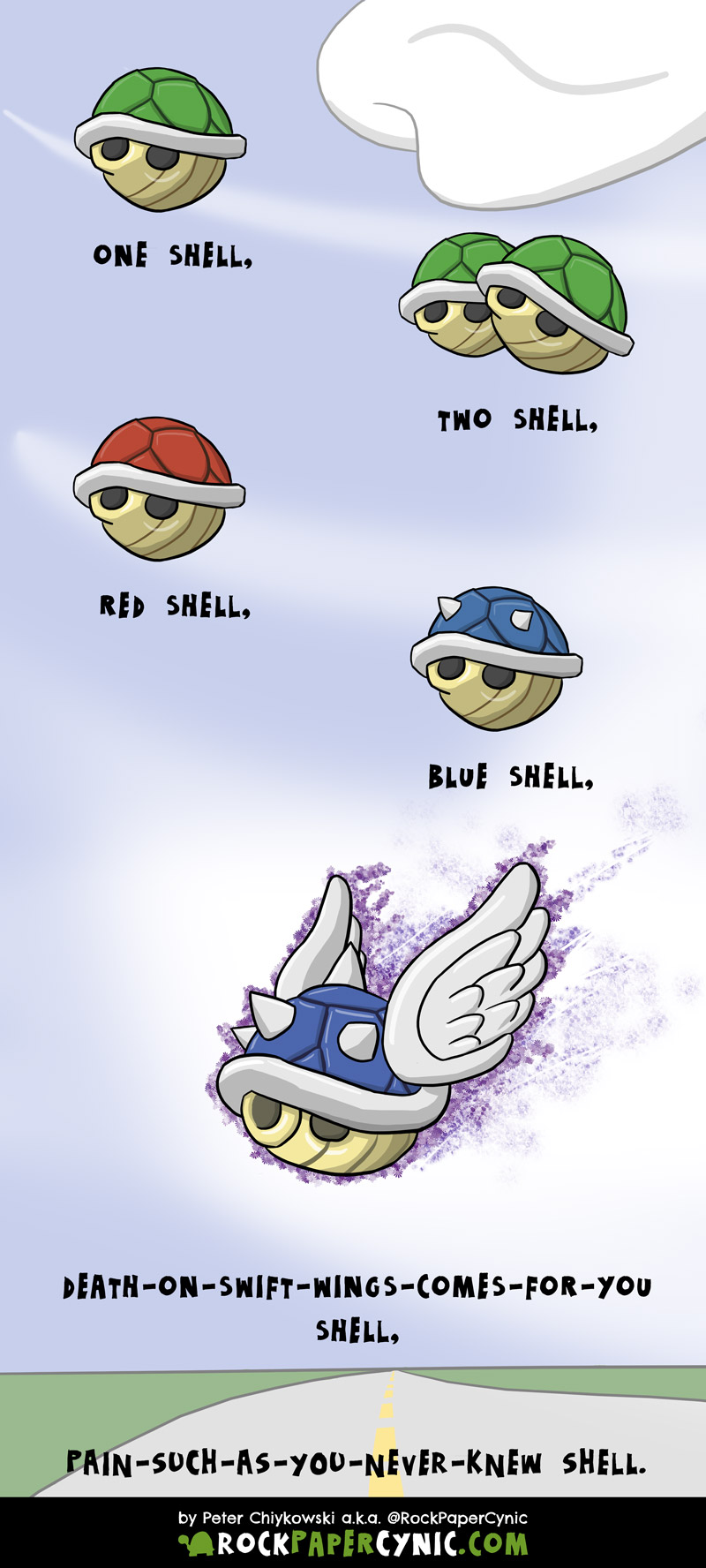 Found this picture online, at Rock, Paper, Cynic, a webcomic. I just thought of posting it up here, well, in dedication to Mario Kart, which will forever serve as an excuse to write up random nonsense and call it philosophy.
Friday, October 16, 2009
Sacrifice: The Risk
In order to gain, you must lose. It can be of equal amount, or not. If the latter, than the difference must be made up with the intangible, such as risk.
Some say that to gain something you desire you must also lose something of equal value to obtain it, such as when you are buying an apple with money. But what of those "bargain prices"? Where the price is less than the value of the apple, then will that rule still apply? Actually, yes, because the company will benefit from this transaction because it will attract more customers, but it does not necessarily mean that it will attract more buyers, there is a risk. So in place of the difference in prices, there needs to be a risk involved in order to balance it out. This rule, the risk rule, states that if the value of gain and the value of loss is unbalanced, risk/luck will become involved in the equation, either leading to greater loss or greater gain, and the amount of loss or gain is dependent on how much risk is involved, like in gambling.
Other factors, such as the loss from another person or time, are included in this relationship of loss and gain, but those will be discussed later.
~C.
Some say that to gain something you desire you must also lose something of equal value to obtain it, such as when you are buying an apple with money. But what of those "bargain prices"? Where the price is less than the value of the apple, then will that rule still apply? Actually, yes, because the company will benefit from this transaction because it will attract more customers, but it does not necessarily mean that it will attract more buyers, there is a risk. So in place of the difference in prices, there needs to be a risk involved in order to balance it out. This rule, the risk rule, states that if the value of gain and the value of loss is unbalanced, risk/luck will become involved in the equation, either leading to greater loss or greater gain, and the amount of loss or gain is dependent on how much risk is involved, like in gambling.
Other factors, such as the loss from another person or time, are included in this relationship of loss and gain, but those will be discussed later.
~C.
Saturday, October 3, 2009
Painful coincidences and other outside forces
There are only two outside forces that interfere with the law of possessions.
They are known as.
Painful coincidences and Luck.
Luck is technically a sub-branch of painful coincidences.
What you call "karma" is inexistence.
There is no karma.
Most bad people will get away with bad things.
However, some of them suffer very unfortunately, from...
Painful coincidences.
Murphy's third law would be of Painful Coincidences.
That when everything is going right
everything is reaching the peak of perfection
only then will everything come crashing down.
In a manner that is so unpredictable, if you are waiting for it to happen, it won't.
Not until you let your guard down.
(note:ilikepressingtheenterkeytoemphasizepoints)
an excerpt from Life, the Universe, and Everything by Douglas Adams.
"Many speak of the legendary and gigantic starship Titanic, a majestic and luxurious cruise liner launched from the great shipbuilding asteroid complexes of Artrifactovol some hundred years ago now, and with good reason.
It was sensationally beautiful, staggeringly huge and more pleasantly equipped than any ship in what remains of history, but it had the misfortune to be built in the earliest days of Improbability Physics, long before this difficult and cursed branch of knowledge was fully, or at all, understood.
The designers and engineers decided, in their innocence, to build a prototype Improbability Field into it, which was meant, supposedly, to ensure that it was Infinitely Improbable that anything would ever go wrong with any part of the ship.
They did not realize that because of the quasi-reciprocal and circular nature of all Improbability calculations, anything that was Infinitely Improbable was actually very likely to happen almost immediately.
The starship Titanic was a monstrously pretty sight as it lay beached like a silver Arctuan Megavoidwhale among the laserlit tracery of its construction gantries, a brilliant cloud of pins and needles of light against the deep interstellar blackness; but when launched, it did not even manage to complete its very first radio message--an SOS--before undergoing a sudden and gratuitous total existence failure."
The law of Painful Coincidences states that improbability of an event occurring is inverse to the probability that it happens immediately.
This law slightly coincides with Murphy's first law.
~BKH
Wish.
Three wishes. No more and no less, says the genie. One wish is far too dangerous; what if the wish was wrong? Two wishes is better, for the second can negate the first. But with three wishes, the lesson is learned, and the wish is for better. Four wishes is one too many, for then the power shall utterly corrupt. Five will destroy, never go beyond that.
What would you do with three wishes? For good or for evil? For self or for all? Gain or lose? With power there are rules, and along with those rules there are consequences. The trick is knowing exactly what the rules are, so the consequences don't turn against you.
So, what would you wish for?
What would you do with three wishes? For good or for evil? For self or for all? Gain or lose? With power there are rules, and along with those rules there are consequences. The trick is knowing exactly what the rules are, so the consequences don't turn against you.
So, what would you wish for?
~C.
Subscribe to:
Posts (Atom)


