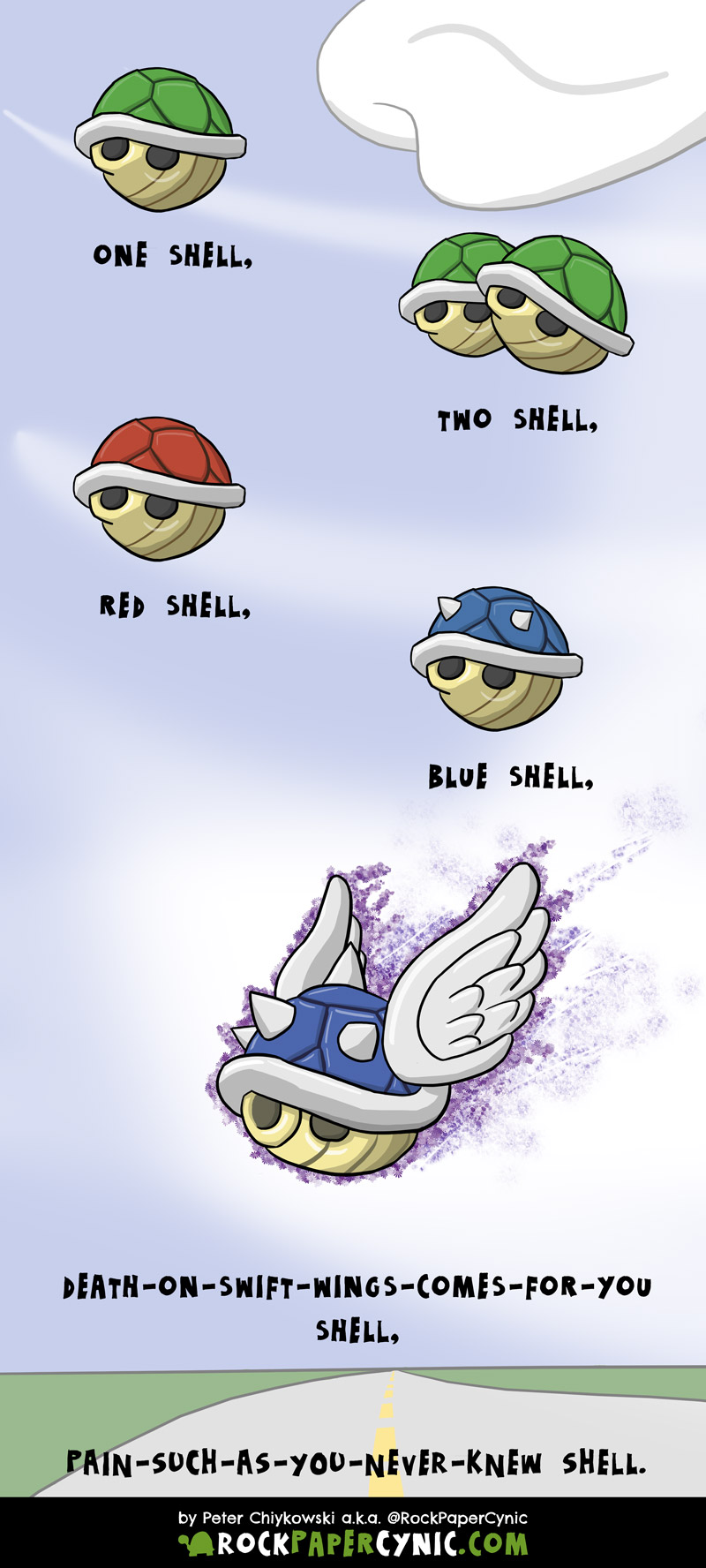
 Found this picture online, at Rock, Paper, Cynic, a webcomic. I just thought of posting it up here, well, in dedication to Mario Kart, which will forever serve as an excuse to write up random nonsense and call it philosophy.
Sunday, October 18, 2009
One shell, Two shell, Red shell, Blue shell.
Found this picture online, at Rock, Paper, Cynic, a webcomic. I just thought of posting it up here, well, in dedication to Mario Kart, which will forever serve as an excuse to write up random nonsense and call it philosophy.

Friday, October 16, 2009
Sacrifice: The Risk
In order to gain, you must lose. It can be of equal amount, or not. If the latter, than the difference must be made up with the intangible, such as risk.
Some say that to gain something you desire you must also lose something of equal value to obtain it, such as when you are buying an apple with money. But what of those "bargain prices"? Where the price is less than the value of the apple, then will that rule still apply? Actually, yes, because the company will benefit from this transaction because it will attract more customers, but it does not necessarily mean that it will attract more buyers, there is a risk. So in place of the difference in prices, there needs to be a risk involved in order to balance it out. This rule, the risk rule, states that if the value of gain and the value of loss is unbalanced, risk/luck will become involved in the equation, either leading to greater loss or greater gain, and the amount of loss or gain is dependent on how much risk is involved, like in gambling.
Other factors, such as the loss from another person or time, are included in this relationship of loss and gain, but those will be discussed later.
~C.
Some say that to gain something you desire you must also lose something of equal value to obtain it, such as when you are buying an apple with money. But what of those "bargain prices"? Where the price is less than the value of the apple, then will that rule still apply? Actually, yes, because the company will benefit from this transaction because it will attract more customers, but it does not necessarily mean that it will attract more buyers, there is a risk. So in place of the difference in prices, there needs to be a risk involved in order to balance it out. This rule, the risk rule, states that if the value of gain and the value of loss is unbalanced, risk/luck will become involved in the equation, either leading to greater loss or greater gain, and the amount of loss or gain is dependent on how much risk is involved, like in gambling.
Other factors, such as the loss from another person or time, are included in this relationship of loss and gain, but those will be discussed later.
~C.
Saturday, October 3, 2009
Painful coincidences and other outside forces
There are only two outside forces that interfere with the law of possessions.
They are known as.
Painful coincidences and Luck.
Luck is technically a sub-branch of painful coincidences.
What you call "karma" is inexistence.
There is no karma.
Most bad people will get away with bad things.
However, some of them suffer very unfortunately, from...
Painful coincidences.
Murphy's third law would be of Painful Coincidences.
That when everything is going right
everything is reaching the peak of perfection
only then will everything come crashing down.
In a manner that is so unpredictable, if you are waiting for it to happen, it won't.
Not until you let your guard down.
(note:ilikepressingtheenterkeytoemphasizepoints)
an excerpt from Life, the Universe, and Everything by Douglas Adams.
"Many speak of the legendary and gigantic starship Titanic, a majestic and luxurious cruise liner launched from the great shipbuilding asteroid complexes of Artrifactovol some hundred years ago now, and with good reason.
It was sensationally beautiful, staggeringly huge and more pleasantly equipped than any ship in what remains of history, but it had the misfortune to be built in the earliest days of Improbability Physics, long before this difficult and cursed branch of knowledge was fully, or at all, understood.
The designers and engineers decided, in their innocence, to build a prototype Improbability Field into it, which was meant, supposedly, to ensure that it was Infinitely Improbable that anything would ever go wrong with any part of the ship.
They did not realize that because of the quasi-reciprocal and circular nature of all Improbability calculations, anything that was Infinitely Improbable was actually very likely to happen almost immediately.
The starship Titanic was a monstrously pretty sight as it lay beached like a silver Arctuan Megavoidwhale among the laserlit tracery of its construction gantries, a brilliant cloud of pins and needles of light against the deep interstellar blackness; but when launched, it did not even manage to complete its very first radio message--an SOS--before undergoing a sudden and gratuitous total existence failure."
The law of Painful Coincidences states that improbability of an event occurring is inverse to the probability that it happens immediately.
This law slightly coincides with Murphy's first law.
~BKH
Wish.
Three wishes. No more and no less, says the genie. One wish is far too dangerous; what if the wish was wrong? Two wishes is better, for the second can negate the first. But with three wishes, the lesson is learned, and the wish is for better. Four wishes is one too many, for then the power shall utterly corrupt. Five will destroy, never go beyond that.
What would you do with three wishes? For good or for evil? For self or for all? Gain or lose? With power there are rules, and along with those rules there are consequences. The trick is knowing exactly what the rules are, so the consequences don't turn against you.
So, what would you wish for?
What would you do with three wishes? For good or for evil? For self or for all? Gain or lose? With power there are rules, and along with those rules there are consequences. The trick is knowing exactly what the rules are, so the consequences don't turn against you.
So, what would you wish for?
~C.
Saturday, September 26, 2009
Logic.
What is logic? Or for that matter, the different logics. People may think differently, their logic not the same as others. But that's not what we're talking about now, right now we shall look into three "logics": logic, unlogic, and the rare inlogic.
You know logic and maaaaayyyyyyyyybe unlogic, which is supposed to be the "complete opposite" of logic. But inlogic is not the opposite of logic or unlogic, it is no logic. For if there is no logic, then there is no unlogic, but if there is no logic, then there exists inlogic.
As of now experts in philosophy (and random blabbering) have almost no clue what inlogic could include, any examples of inlogic, and the significance of inlogic. But if we have almost no clue, then that means that we have a little bit of a clue as to what it is, the examples and the significance. For example, take the universe. We don't really know how big the universe is, but outside of the universe there might exist inlogic for all matter is contained inside of the universe, and if there is nothing, then there is no logic which is actually inlogic. Now say that the universe will collapse and all life will be destroyed, then, if we could use our knowledge of inlogic and be able to harness it's probable powers, we could survive OUTSIDE of the universe and be able to keep humanity going, and not all die.
There are many frontiers that we have not explored yet, and many "logics" to discover, so bear wtih us as we explore THE DEEP FRONTIER. Or just incessantly babble random things.
~C
You know logic and maaaaayyyyyyyyybe unlogic, which is supposed to be the "complete opposite" of logic. But inlogic is not the opposite of logic or unlogic, it is no logic. For if there is no logic, then there is no unlogic, but if there is no logic, then there exists inlogic.
As of now experts in philosophy (and random blabbering) have almost no clue what inlogic could include, any examples of inlogic, and the significance of inlogic. But if we have almost no clue, then that means that we have a little bit of a clue as to what it is, the examples and the significance. For example, take the universe. We don't really know how big the universe is, but outside of the universe there might exist inlogic for all matter is contained inside of the universe, and if there is nothing, then there is no logic which is actually inlogic. Now say that the universe will collapse and all life will be destroyed, then, if we could use our knowledge of inlogic and be able to harness it's probable powers, we could survive OUTSIDE of the universe and be able to keep humanity going, and not all die.
There are many frontiers that we have not explored yet, and many "logics" to discover, so bear wtih us as we explore THE DEEP FRONTIER. Or just incessantly babble random things.
~C
Saturday, September 19, 2009
More On the Law of Possessives
More on The Law of Possessives
The Law of Possessives is seen in this example:
Cody and Brian go to Eric’s house to play Mario kart wii. Cody brings his wiimote and a cellphone. Brian brings a psp and a cellphone. The following describes what each person possesses.
Brian: Luck, PSP, Cellphone
Cody: High skill, Wiimote, Cellphone
Eric: Skill, House, Wii, Game, Everything inside house, Wiimote, Cellphone.
Cody has brought a Wiimote and Brian has brought a PSP. While PSP beats Wiimote in awesomeness, Wiimote is used in the actual game, and the PSP does not. Therefore, Wiimote beats PSP in possession.
Cody has high skill, and Eric has skill. Cody beats Eric in that regard.
Luck is an outside force and will be focused on in my next lecture/post.
Eric, Cody, and Brian all own cellphones, and though Eric’s phone beats Brian’s phone which beats Cody’s phone, they are not used in the game, so their possessive awesomeness is reduced to a third of its original.
Everything Eric owns besides the cellphone can relate to the game, from the couch Brian sits on to the pillows that Cody sit on to the TV screen itself, so Eric naturally has the highest possessive awesomeness.
Therefore, it is understood that unless an outside force exerts itself, Eric will win every race, and Cody will beat Brian in every race.
Next time: Outside forces that can cancel the Law of Possessives
The Law of Possessives is seen in this example:
Cody and Brian go to Eric’s house to play Mario kart wii. Cody brings his wiimote and a cellphone. Brian brings a psp and a cellphone. The following describes what each person possesses.
Brian: Luck, PSP, Cellphone
Cody: High skill, Wiimote, Cellphone
Eric: Skill, House, Wii, Game, Everything inside house, Wiimote, Cellphone.
Cody has brought a Wiimote and Brian has brought a PSP. While PSP beats Wiimote in awesomeness, Wiimote is used in the actual game, and the PSP does not. Therefore, Wiimote beats PSP in possession.
Cody has high skill, and Eric has skill. Cody beats Eric in that regard.
Luck is an outside force and will be focused on in my next lecture/post.
Eric, Cody, and Brian all own cellphones, and though Eric’s phone beats Brian’s phone which beats Cody’s phone, they are not used in the game, so their possessive awesomeness is reduced to a third of its original.
Everything Eric owns besides the cellphone can relate to the game, from the couch Brian sits on to the pillows that Cody sit on to the TV screen itself, so Eric naturally has the highest possessive awesomeness.
Therefore, it is understood that unless an outside force exerts itself, Eric will win every race, and Cody will beat Brian in every race.
Next time: Outside forces that can cancel the Law of Possessives
Friday, September 18, 2009
Introducing...Tongs!
Haha, okay. : |
Mister Chao has let me into this Blarghed information network known.
One of the reasons is because I was involved in the conception of Laws of Posessions (see second post) and the post about desire and ignorance driving all human nature (see third post) was born out of a conversation we had.
Probably the second reason is that alone, we stand about 75% chance of forgetting to update the bhlog. Together, the chance of us both forgetting is around 30%.
Third is because I asked him and he's a great friend like that.
Apparently I opened up a whole new dimmension of in/un/logic for this blog with my Taoist book of quotes, too.
First order of the day, I will invent a new word. See you later.
Subscribe to:
Posts (Atom)


